
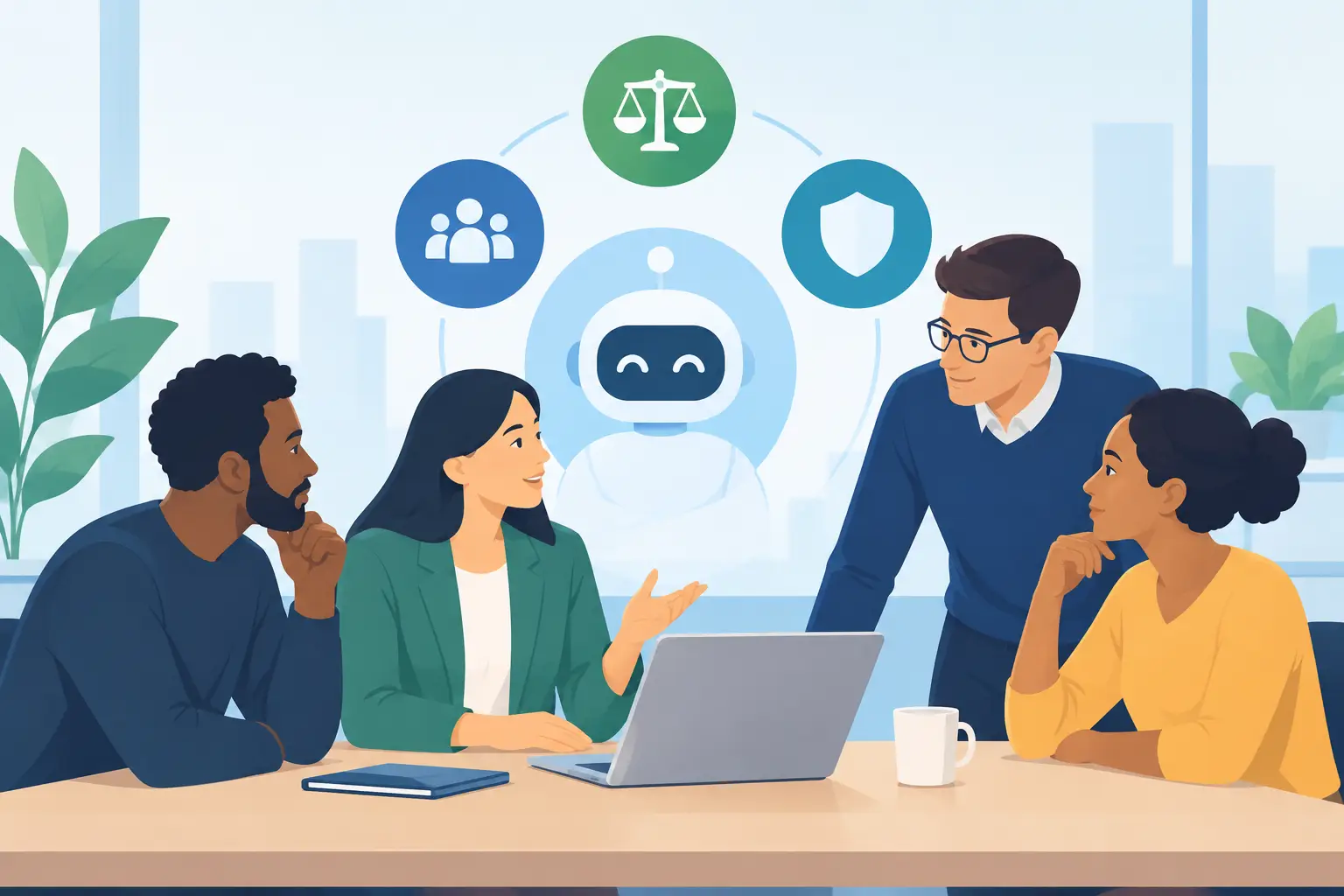
A sales manager pastes a customer call transcript into an AI tool to prepare for a meeting. A hiring lead uses a chatbot to condense candidate notes. A small business owner asks an assistant to draft a proposal based on client information. Each decision may save time. Each can also expose private data, reinforce a bad judgment, or create a promise nobody has reviewed.
That is why a guide to workplace AI ethics is not a corporate compliance exercise for someone else to handle. It is practical career insurance. The people who thrive in an AI-driven economy will not simply know how to produce faster. They will know how to use powerful tools in a way that earns trust, protects people, and strengthens the reputation of the organizations they serve.
AI can expand opportunity for workers, entrepreneurs, and small teams. It can help turn a blank page into a plan, surface patterns in large amounts of information, and free people to focus on relationships and judgment. But opportunity without standards can become a shortcut to avoidable damage. Ethics gives innovation a direction.
Why workplace AI ethics is a career advantage
Many workers hear “AI ethics” and think of abstract debates about the future. In reality, it often comes down to ordinary professional questions: Should this information be entered into an AI system? Can I trust this recommendation? Who might be harmed if it is wrong? Have I been honest about how this work was created?
Your answers affect more than a single task. Customers decide whether to share data with companies they trust. Employees decide whether leadership is using technology to support them or quietly monitor and replace them. Managers decide whom to rely on when a high-stakes decision requires more than a polished machine-generated response.
Ethical AI use does not mean refusing to use AI. It means refusing to hand over human responsibility. That distinction matters. A calculator can produce an answer, but it cannot explain the business context behind it. An AI assistant can draft a message, but it cannot own the relationship if that message misleads a customer. Human accountability remains the asset that technology cannot replace.
For ambitious professionals, this creates a clear opening. Become the person who can use AI productively while also asking the questions that protect the team. That combination of technical confidence and sound judgment will stand out in nearly every industry.
A guide to workplace AI ethics: start with human responsibility
The simplest rule is also the most valuable: a person must remain accountable for the outcome. AI can assist with research, writing, analysis, scheduling, and creative work. It should not become an excuse to stop thinking.
Before acting on an AI output, ask whether you can explain and defend the decision to the people affected by it. If an AI tool recommends denying a loan, screening out an applicant, changing a customer’s service level, or flagging an employee for review, the stakes are high. A human with authority should understand the basis for the recommendation, challenge it when necessary, and make the final call.
This does not require every employee to become a data scientist. It requires intellectual ownership. Read the output. Check the facts. Look for missing context. Consider whether the answer makes sense for the real person, client, or situation in front of you.
The right level of review depends on the consequences. A first draft of an internal meeting agenda may need a quick edit. A financial forecast, legal communication, medical-related message, hiring decision, or public statement deserves far more scrutiny. Efficiency is valuable, but not when the cost of being wrong is someone’s livelihood, privacy, safety, or trust.
Protect private and sensitive information
Data is one of the first ethical pressure points at work. Public AI tools may process, retain, or use submitted information according to terms your employer has not approved. Entering confidential strategy documents, customer records, employee performance details, trade secrets, or personal health information into the wrong tool can create a serious problem in seconds.
Use only AI systems your organization has approved for the information involved. If there is no clear policy, assume sensitive material should stay out until you receive guidance. When possible, remove names, account numbers, addresses, and details that could identify a person or business.
Small business owners should apply the same discipline. A client hired you because they expect professional discretion, not because they expect their information to become raw material for an experiment. Privacy is not a barrier to growth. It is part of the trust that makes sustainable growth possible.
Watch for bias, especially when people are affected
AI learns patterns from human-created data, and human systems have never been perfectly fair. That means an AI tool can repeat old biases or create new ones at scale. The risk becomes especially serious in hiring, promotion, compensation, lending, housing, insurance, education, and workplace discipline.
Bias is not always obvious. An AI-generated candidate ranking may appear neutral while giving too much weight to proxies for background, geography, writing style, or past access to opportunity. A customer service system may misunderstand dialects or treat some groups differently. A productivity score may reward what is easy to measure rather than what actually creates value.
The answer is not to assume every AI result is biased, nor to assume an impressive interface is objective. Ask what data and criteria shaped the result. Compare outcomes across groups when the decision has a meaningful impact. Give people a way to correct errors or request human review. Fairness is not achieved by checking a box once. It is maintained through attention.
Be honest about AI’s role in the work
Transparency builds credibility. If AI substantially created a report, image, analysis, or customer-facing message, the right disclosure depends on your workplace rules, audience expectations, and the stakes of the work. There is a difference between using AI to brainstorm a few options and presenting unverified AI analysis as if you performed it yourself.
In many cases, simple clarity is enough: AI assisted with an early draft, and a qualified employee reviewed and revised the final version. In other cases, disclosure may be essential, particularly where customers, regulators, or decision-makers need to understand how an outcome was produced.
Transparency also protects your personal reputation. Do not let speed pressure you into claiming expertise you did not apply. Use the tool, improve the work, and own the final result. That is professional leverage, not deception.
Respect intellectual property and original work
AI makes it easy to generate text, code, images, and ideas quickly. Easy does not always mean yours to use without question. Outputs can resemble existing work, contain inaccurate claims about ownership, or violate client and employer expectations.
Treat AI-generated material as a starting point, not proof of permission. Review it for copied language, brand conflicts, unsupported claims, and material that may require a license or attribution. If your role involves publishing, marketing, software, design, or client deliverables, follow the standards established by your employer and the agreements made with customers.
Original thinking still has a market. AI can help you move faster, but your experience, judgment, values, and understanding of a customer’s real problem are what turn generic output into meaningful work.
Build ethical habits before a crisis forces them
Good AI ethics becomes real through repeatable behavior, not a poster on a wall. Teams need a clear understanding of which tools are approved, what data may be used, where human review is required, and who can answer questions when a new use case appears.
Leaders should make it safe for employees to raise concerns. If a worker notices that an AI tool is producing inaccurate results or using questionable information, that person should be seen as protecting the business, not resisting progress. The strongest organizations do not choose between innovation and caution. They create a culture where people can test, learn, document, and improve without hiding problems.
For professionals building their own careers, create a personal pause point before using AI for meaningful work. Consider the purpose, the data, the people affected, and the consequences if the output is wrong. Then verify what matters. This habit takes minutes, yet it can prevent the kind of mistake that follows a career for years.
AI will continue to change how Americans work, compete, and create wealth. The future belongs neither to those who fear every new tool nor to those who use them carelessly. It belongs to people who pair ambition with responsibility. Make that your standard, and every new technology becomes another chance to lead with skill, character, and confidence.
