
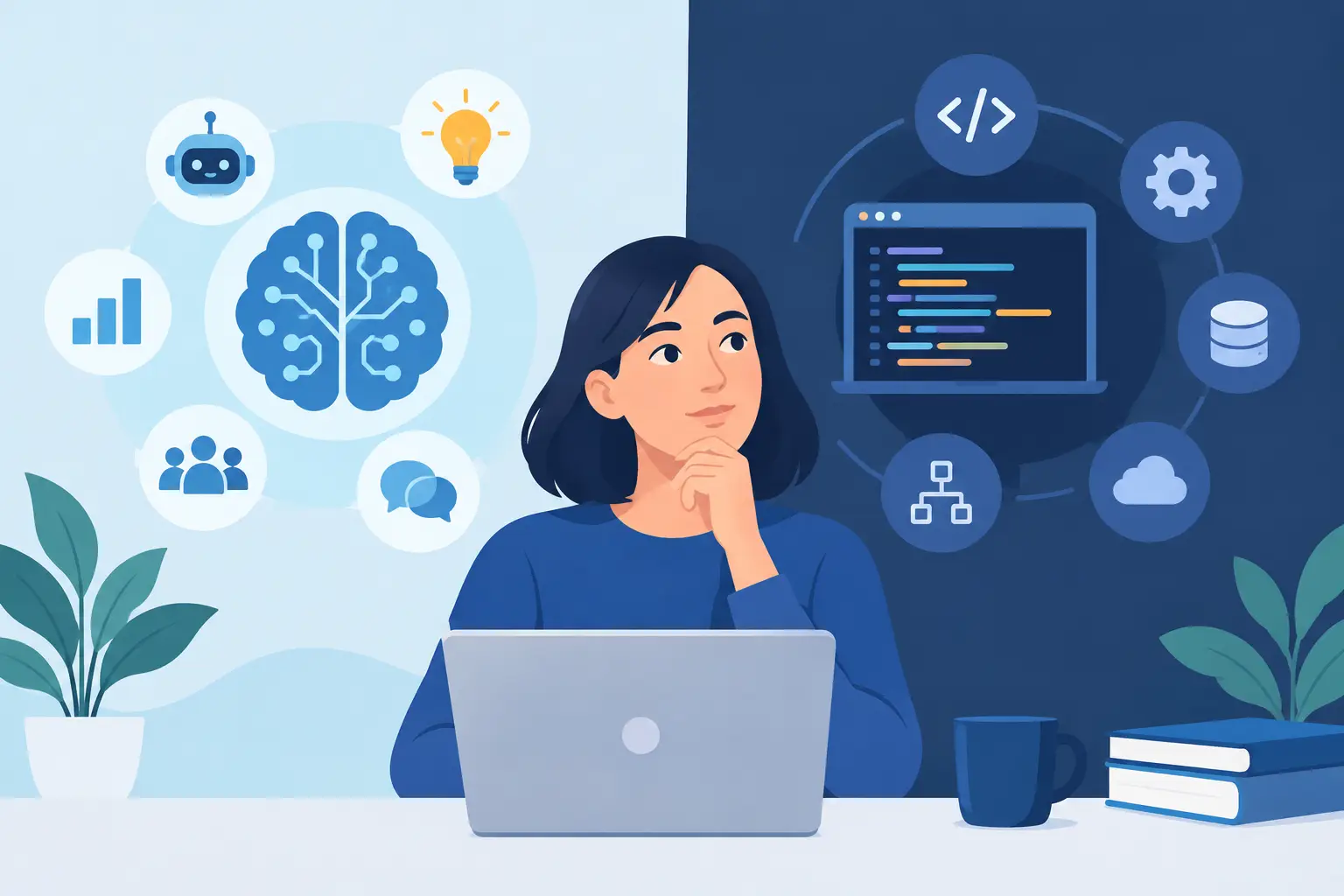
A marketing manager asks an AI tool to analyze customer feedback. A warehouse supervisor uses one to improve scheduling. A small business owner drafts a sales plan, spots weak assumptions, and revises it before a dollar is spent. None of them needs to become a software engineer to benefit. That is the real question behind AI literacy versus coding: which capability gives ordinary ambitious people the strongest position in an economy being reshaped by intelligent tools?
The answer is not that coding has lost its value. Coding remains a high-leverage skill, especially for people who want to build software, automate complex systems, or work directly in technology. But AI literacy is becoming a broader requirement. It is the ability to understand what AI can do, where it fails, how to direct it well, and how to use its output responsibly to create better results.
For most professionals, AI literacy will be the first skill to build. For some, coding will become the next step. The opportunity is not to choose a side. It is to choose the level of technical skill that turns your ambition into measurable value.
AI Literacy Versus Coding Is Not a Status Contest
For years, coding carried a special kind of career prestige. It signaled that someone could make technology, not merely use it. That is still true. A skilled developer can create products, customize workflows, and solve technical problems that most people cannot touch.
But the rise of AI changes the starting point. You no longer need to write every line of code to build a useful workflow, create a prototype, analyze a spreadsheet, generate a first draft, or automate a routine task. Natural-language interfaces have lowered the barrier between an idea and an experiment.
That does not mean the barrier has disappeared. Someone still needs judgment. Someone needs to decide whether the task is appropriate for AI, whether the data is reliable, whether an answer is accurate, and whether a process protects customers, employees, and the business. Those are AI literacy skills.
Think of it this way: coding helps you build the engine. AI literacy helps you decide where to drive, read the dashboard, and avoid steering into a ditch. Organizations need both. Yet a company with only technical builders and no leaders, operators, salespeople, or managers who understand AI will leave enormous value on the table.
What AI Literacy Actually Means
AI literacy is not memorizing technical vocabulary or collecting prompts from social media. It is practical fluency. A literate AI user can translate a real business or career problem into a clear request, examine the response, and improve the process over time.
It also requires healthy skepticism. Generative AI can produce polished language that sounds confident while being incomplete or wrong. It can reflect bias in its training data. It can expose sensitive information if people use it carelessly. A person who treats every output as fact is not AI-literate, no matter how quickly they can produce a report.
At work, AI literacy includes knowing how to ask useful questions, provide context, verify claims, and retain accountability. It means understanding that AI can assist with a decision without owning the decision. It means recognizing when a task calls for human empathy, professional judgment, legal review, or subject-matter expertise.
This is why AI literacy belongs to people in every department. A nurse, accountant, teacher, realtor, project manager, trades business owner, and customer service professional will use AI differently. The common advantage is not a single tool. It is the ability to pair domain knowledge with intelligent assistance.
When Coding Creates a Bigger Advantage
Coding deserves serious consideration when your goals require deeper control. If you want to become a software developer, data professional, machine learning engineer, or technical founder, programming is not optional. You need to understand how systems are built, tested, connected, and maintained.
It can also be worthwhile for professionals outside traditional technology roles. A financial analyst who learns enough Python to automate recurring reporting can save hours every week. An operations leader who understands APIs and basic scripting can connect systems that otherwise create costly manual work. An entrepreneur who can build a rough product prototype may test an idea faster and with less capital.
Still, coding is an investment. Learning it well takes sustained practice, patience with errors, and time spent understanding logic rather than simply copying snippets. AI can accelerate that learning, but it cannot replace the foundational thinking required to diagnose a broken program or design a dependable system.
The deciding question is simple: will coding help you create value that your current tools cannot? If the answer is yes, pursue it with purpose. If the answer is no, do not let the pressure to become technical distract you from building AI fluency and excellence in your own field.
The New Career Advantage Is Combination
The strongest career position is increasingly built at the intersection of human expertise and AI capability. A lawyer who understands contracts and knows how to use AI safely can serve clients more efficiently. A sales professional who combines relationship skills with AI-powered research can prepare more strategically. A contractor who uses AI for estimates, customer follow-up, and job planning can compete with larger firms without adding overhead.
This is where the American Dream remains alive and practical. Technology can concentrate power, but it can also put capabilities once reserved for large organizations into the hands of individuals who are willing to learn. The person who identifies a problem, adopts useful tools, and follows through with discipline can create more opportunity than the person who waits for certainty.
Your expertise matters more, not less, when AI is everywhere. AI can generate options, but it does not automatically understand your customers, your reputation, your local market, or the standards you refuse to compromise. Those human assets are the foundation. AI becomes a multiplier when it is guided by someone who knows what good work looks like.
A Practical Path for Working Professionals
Start with your current work, not with an abstract fear of being replaced. Identify one recurring task that takes time but does not require your full creative attention. It might be organizing meeting notes, drafting routine communications, summarizing research, creating a project outline, or finding patterns in customer comments.
Use AI to assist with that task, then compare the result against your own standards. What did it get right? What did it miss? What context would have improved the output? This process builds the most valuable habit of all: informed judgment.
Next, learn enough about data privacy, bias, copyright, and verification to use AI responsibly. Never paste confidential company or client information into a tool unless you are authorized to do so and understand the platform's policies. Convenience is never worth damaging trust.
Then expand from individual productivity to problem-solving. Ask where AI could improve a customer experience, reduce waste, speed up a decision, or help you test a business idea. This is the shift from using AI as a shortcut to using it as a strategic tool.
If you find yourself repeatedly limited by what off-the-shelf tools can do, that is your signal to explore coding, automation platforms, or technical partnerships. Let real needs guide the next skill you learn.
The Risk of Choosing Only One
People who dismiss AI because they are not coders may miss a powerful source of career growth. They may continue doing manual work that competitors are learning to improve, and eventually wonder why their productivity or opportunities have stalled.
On the other hand, people who focus only on code may underestimate the value of communication, leadership, industry knowledge, and sound decision-making. A technically impressive solution that solves the wrong problem is still a poor investment.
The future will reward people who can move between these worlds. They will understand enough technology to ask better questions and enough human reality to apply the answers wisely. They will not be intimidated by AI, and they will not be fooled by its promises.
You do not have to become an engineer to claim a place in the AI economy. Begin by becoming the person in your workplace or business who can use AI with clarity, care, and initiative. Then keep building. Every practical skill you add becomes another brick in the future you are determined to own.
