
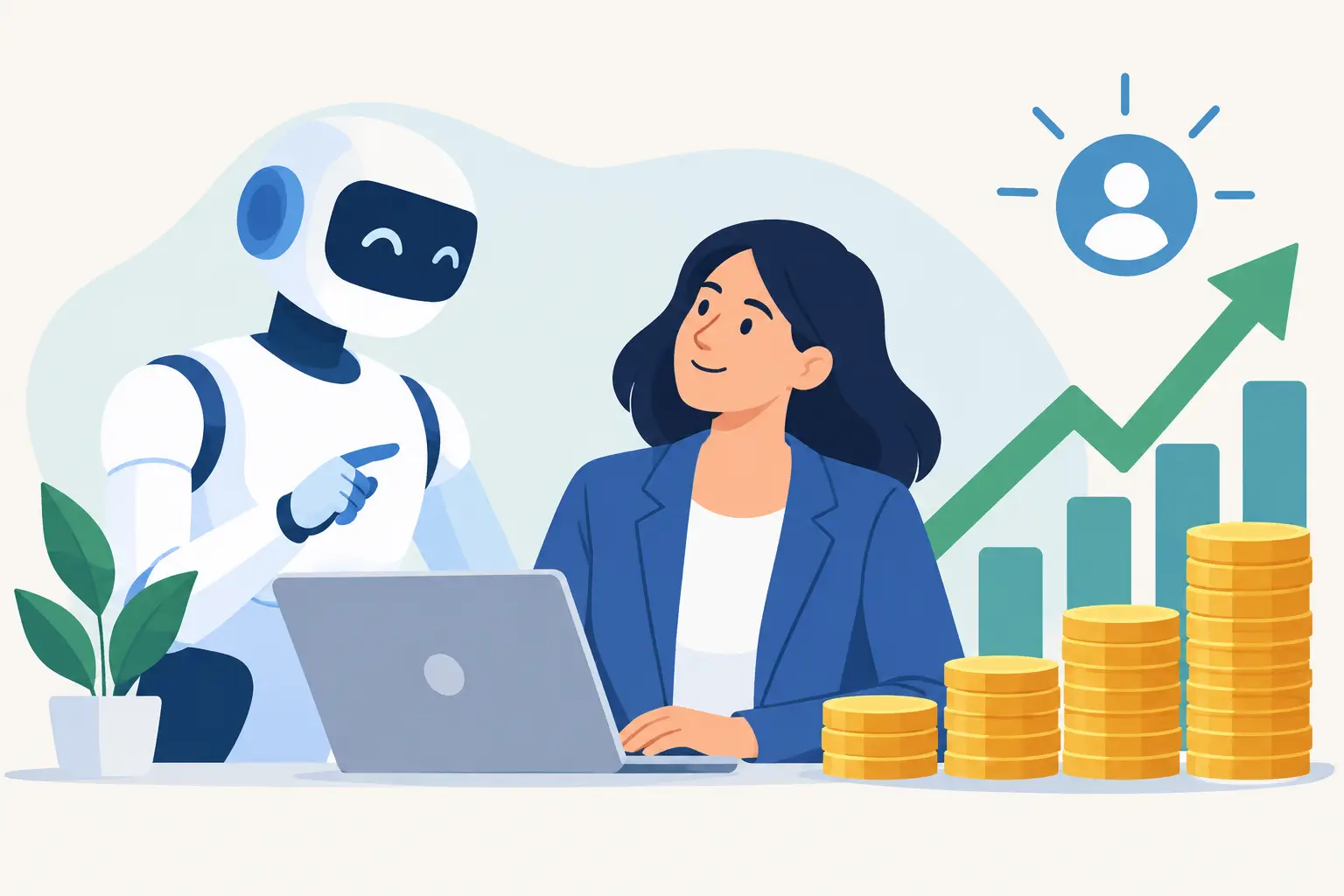
A worker who uses AI to finish a client proposal in two hours instead of six has not automatically earned more money. But that worker has created something valuable: capacity. The real question behind can AI improve wages is whether people, employers, and entrepreneurs will turn that capacity into better results, stronger leverage, and greater income.
AI will not raise every paycheck by default. It can also be used to cut costs, reduce entry-level work, and concentrate rewards among the people who already own the technology. Yet for Americans willing to learn, adapt, and create, AI can become one of the most practical tools for upward mobility in a generation.
Can AI Improve Wages for Everyday Workers?
Yes, but the answer depends on how AI changes your value in the marketplace. Wages rise when an employee can help a business make more money, save meaningful time, reduce costly mistakes, serve customers better, or take on responsibilities that once required a larger team.
AI can help people do each of those things. A marketing coordinator can produce better first drafts, analyze customer feedback, and test more campaign ideas. A project manager can organize meeting notes, identify risks, and keep a team moving. A skilled trades business owner can respond to leads faster, write clearer estimates, and spend less time buried in paperwork.
The technology is not the source of the higher wage by itself. Your ability to apply it to a real business problem is what creates economic value. That distinction matters. Anyone can ask a chatbot for generic ideas. The person who understands customers, knows the work, checks the output, and makes sound decisions becomes more valuable.
This is why AI rewards judgment, not just speed. Fast work that is inaccurate, careless, or disconnected from the customer does not create lasting opportunity. Fast work paired with expertise can.
The Wage Gap May Grow Before It Narrows
There is a hard truth worth facing: AI may widen wage gaps in the short term. Workers who have strong communication skills, industry knowledge, and access to training may pull ahead quickly. People whose jobs consist mainly of routine, repeatable tasks may face more pressure.
That does not mean the future belongs only to programmers or executives. It means the old strategy of waiting for a job description to stay the same is becoming riskier. The worker who learns to use AI well can often produce at a higher level without needing a computer science degree.
Consider two insurance representatives. One spends much of the day manually summarizing calls, drafting follow-up emails, and searching through policy documents. The other uses approved AI tools to prepare summaries, organize information, and create a clear first draft of each customer response. The second representative still needs product knowledge, compliance awareness, and empathy. But with less administrative drag, that person can focus on advising clients, retaining accounts, and generating revenue.
That is the path from AI adoption to wage growth. It is not about replacing human contribution. It is about moving human contribution toward work that commands more trust and produces better outcomes.
Higher Pay Comes From Greater Leverage
For generations, the American Dream has rested on a simple principle: build useful skills, work hard, and create more value over time. AI does not erase that principle. It changes the tools available to put it into practice.
Leverage means your effort reaches farther than it could on its own. A writer can research and revise more efficiently. A salesperson can prepare for conversations with greater insight. A nurse manager can reduce documentation time. A local business can create training materials, customer messages, and operating procedures without hiring a large back-office team.
Used responsibly, AI gives an individual more leverage. That can lead to a raise, a promotion, higher commissions, a better-paying role, or a business with room to grow. But leverage only turns into income when you make it visible.
If AI helps you save five hours a week, do not treat that time as a private productivity trick. Use it to take ownership of a project, improve a key process, deepen a client relationship, or build a capability your team needs. Then document the result. Employers reward outcomes more reliably than effort they cannot see.
A useful question is: What important result can I now deliver that I could not reliably deliver before? The answer may reveal your next step toward higher earnings.
Build a Skill Stack, Not Just an AI Habit
The strongest career strategy is not becoming dependent on one tool. AI platforms will change, features will come and go, and companies will choose different systems. What lasts is a skill stack: the combination of human strengths and practical AI capability that makes you difficult to replace.
Your stack might include industry knowledge, clear writing, data literacy, sales ability, customer service, leadership, financial judgment, and the ability to use AI to accelerate quality work. For an entrepreneur, it may also include pricing, operations, marketing, and the discipline to turn ideas into a dependable service.
Start with the work you already understand. Identify one recurring task that takes too long or produces uneven results. Learn how AI can assist with the first draft, research, organization, analysis, or communication involved. Then keep your own standards high. Check facts. Protect confidential information. Edit for accuracy and tone. Never hand over judgment simply because a tool produced a confident answer.
This approach builds credibility. Instead of saying, “I know AI,” you can say, “I reduced our proposal turnaround time, improved follow-up consistency, and helped us win more business.” That is language a manager, customer, or future employer can understand.
Employers Must Share the Gains
There is also a leadership question. If AI makes a company more productive, who receives the benefit? If every gain flows only to owners while employees face heavier workloads or job cuts, technology will deepen distrust. That is neither sustainable nor worthy of the kind of economy Americans should want to build.
Forward-looking employers will use AI to grow people alongside profits. They will train employees, redesign jobs around higher-value work, reward measurable improvements, and create advancement paths for people who develop new capabilities. They will recognize that a workforce with stronger skills is not merely a cost center. It is a competitive advantage.
Workers should not assume this will happen automatically. Ask direct questions. What AI tools is the company adopting? Which tasks will change? What training is available? How will new skills affect advancement and compensation? These are reasonable career questions, not signs of resistance.
Turn AI Learning Into Earning Power
The most productive response to AI anxiety is focused action. Choose one part of your work where better speed, quality, or insight would matter. Practice with real examples. Measure what improves. Learn enough about the limits of the tool to avoid preventable mistakes.
Then expand from productivity to opportunity. If you are employed, look for problems your manager cares about: delayed projects, customer complaints, inconsistent reporting, missed follow-ups, or slow onboarding. If you run a business, look for work that keeps you from selling, serving, or improving your offer. AI is most valuable when it removes friction from the work that moves your goals forward.
Do not wait for perfect certainty. The people who benefit most from a changing economy are rarely the ones who predicted every shift. They are the ones who stayed curious, developed useful skills, and acted before opportunity became crowded.
AI can improve wages, but it will reward intentional people more than passive observers. Treat it as a tool for becoming more capable, more useful, and more free to shape your future. The next raise may begin not with a new job title, but with the decision to become the person who can do more meaningful work when the future asks for it.
