
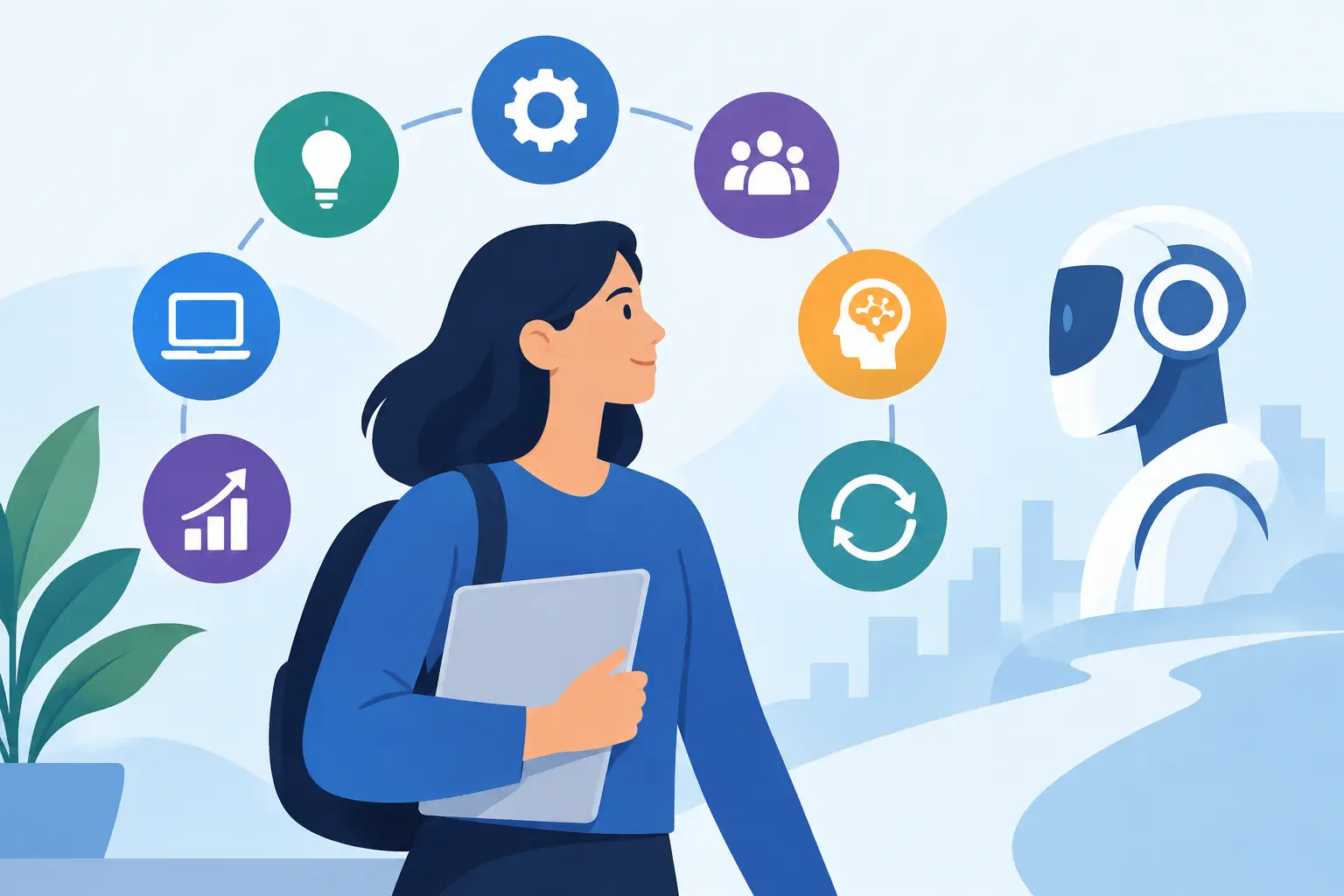
A job description can change faster than a person’s confidence. One quarter, your employer is asking for better reporting. The next, it expects employees to use AI tools, communicate across departments, or take ownership of work that once belonged to an entire team. The question is not whether change is coming. It is how to build adaptable skills before change forces your hand.
Adaptability is not about chasing every new app, abandoning your experience, or pretending that disruption is easy. It is the ability to recognize what is changing, learn what matters, and apply your strengths in a new situation. For Americans pursuing career security, business growth, and greater freedom, that ability is becoming one of the most valuable assets they can own.
Why Adaptable Skills Matter More Than a Fixed Job Title
For decades, many people built careers around a stable bargain: learn a profession, work hard, gain experience, and move steadily upward. Hard work still matters. Experience still matters. But the shelf life of specific tasks is getting shorter as artificial intelligence, automation, and new business models reshape how value is created.
That does not mean people are becoming less important. It means routine work is becoming easier to automate, while judgment, initiative, communication, and problem-solving become more visible. A professional who can use AI to draft a first report, then apply industry knowledge to improve it, is more valuable than someone who can only complete the old process by hand. A small business owner who can test new marketing ideas quickly has an advantage over one who waits for certainty.
Adaptable skills give you options. They help you move into a new role, improve your performance in your current one, or spot an opportunity to create something of your own. That is a more durable form of career resilience than relying on a title that may not exist in the same form five years from now.
How to Build Adaptable Skills Without Starting Over
The most effective approach is not to reinvent your life every time technology changes. Start by identifying the parts of your work that are likely to remain valuable, then build the ability to apply them in new ways.
Your existing experience is not baggage. A nurse understands patient trust. A project manager understands coordination. A salesperson understands customer hesitation. A tradesperson understands how to diagnose problems under real-world conditions. AI can process information at tremendous speed, but it does not automatically possess your context, accountability, or earned judgment.
The goal is to pair that human experience with a learning habit. Rather than asking, “Will AI replace my job?” ask a more useful question: “Which parts of my work could AI help me do better, faster, or differently?” That question turns uncertainty into a practical next step.
Build learning into your regular schedule
People often delay learning because they imagine it requires a return to school or hours of free time they do not have. Formal education can be valuable, especially when a field requires credentials. But most career adaptability is built through consistent, focused practice.
Set aside a small block of time each week to study a capability connected to your goals. If you work in operations, that may mean learning how to analyze data with an AI assistant. If you lead people, it may mean practicing how to give clearer feedback and make decisions with incomplete information. If you run a business, it may mean learning to create better offers, research customer needs, or organize your workflow.
The key is application. Read less just to feel informed. Practice more so that you can produce a result. Use a new tool to improve a real email, organize a real project, create a real proposal, or solve a real customer problem. Confidence comes from evidence that you can use a skill, not simply from watching someone else explain it.
Strengthen the skills AI makes more valuable
Technical fluency matters, but adaptable people do not depend on technical fluency alone. They develop the human capabilities that help technology produce useful outcomes.
Clear communication is one. If you can explain a problem, ask thoughtful questions, and tailor a message to the person in front of you, you become easier to trust and more effective in any industry. Critical thinking is another. AI can generate an answer, but you must evaluate whether the answer is accurate, ethical, relevant, and appropriate for the stakes involved.
Also develop judgment, emotional intelligence, and the ability to learn from feedback. These are not soft skills in the sense of optional skills. They are leadership skills. The professional who can calm a frustrated client, align a team around a priority, or make a responsible call when the data is unclear will continue to stand out.
Practice being a beginner on purpose
Many capable adults avoid new tools because they do not want to feel inexperienced. That reaction is understandable, especially when your reputation has been built on competence. But adaptability requires a willingness to be new at something without confusing beginner status with failure.
Give yourself permission to experiment. Ask a colleague how they are using a tool. Take notes on what works and what does not. Make a small mistake in a low-risk setting, then improve. The people who advance through change are rarely the ones who know everything first. They are the ones who learn openly and keep moving.
This does not mean adopting every trend. Good adaptability includes discernment. Some tools will not fit your work. Some training programs will not be worth the time or money. Before committing, consider whether a new skill solves a genuine problem, strengthens a direction you want to pursue, or gives you a capability employers and customers can recognize.
Turn Curiosity Into Career Proof
Learning becomes more powerful when other people can see its results. A future employer, client, or business partner does not only want to hear that you are adaptable. They want evidence.
Create small proof points as you learn. Improve a process at work and document the outcome. Build a sample project. Volunteer to help with a cross-functional initiative. Use AI to create a more organized client follow-up system, then measure whether response times improved. These examples show that you do more than follow instructions. You find better ways forward.
Your proof does not have to be flashy. It has to be specific. “I helped reduce the time required to prepare weekly reports” says more than “I am proficient with AI.” “I developed a customer FAQ that reduced repetitive support requests” shows initiative, communication, and business awareness at the same time.
For job seekers, this proof can shape stronger interviews and resumes. For entrepreneurs, it can become a case study that builds trust with customers. For employees, it can make the case for greater responsibility, a new role, or a raise.
Build an Adaptability Network
No one sees change clearly alone. People in different roles notice different shifts in customer expectations, workplace needs, and emerging technology. A strong network gives you perspective before you urgently need an answer.
Stay connected to people who are building, learning, and doing work outside your immediate routine. That may include colleagues in another department, business owners in your community, professionals who made a successful career transition, or younger workers with fresh familiarity with emerging tools. Listen for patterns, not hype.
Be useful in those relationships. Share an idea, make an introduction, or offer help on a project. Career opportunity often grows from a reputation for curiosity and contribution. The American Dream has always involved individual effort, but individual effort becomes stronger when it is supported by relationships, trust, and shared knowledge.
Choose Progress Over Perfect Certainty
There is a trade-off in every decision to adapt. Spend too much time chasing change, and you can lose focus on the work that pays the bills and serves your customers. Ignore change for too long, and you may find yourself scrambling when your industry has already moved.
The answer is not fear. It is steady, intentional progress. Choose one skill that supports your next career move. Use it in a real situation. Learn what you need next. Then repeat the process.
The future will reward people who can combine ambition with flexibility. You do not need to predict every turn in the economy to prepare for it. Build the habit of learning, the courage to test new approaches, and the discipline to turn knowledge into useful work. That is how you keep writing your own American Dream, even when the rules of work change.
