
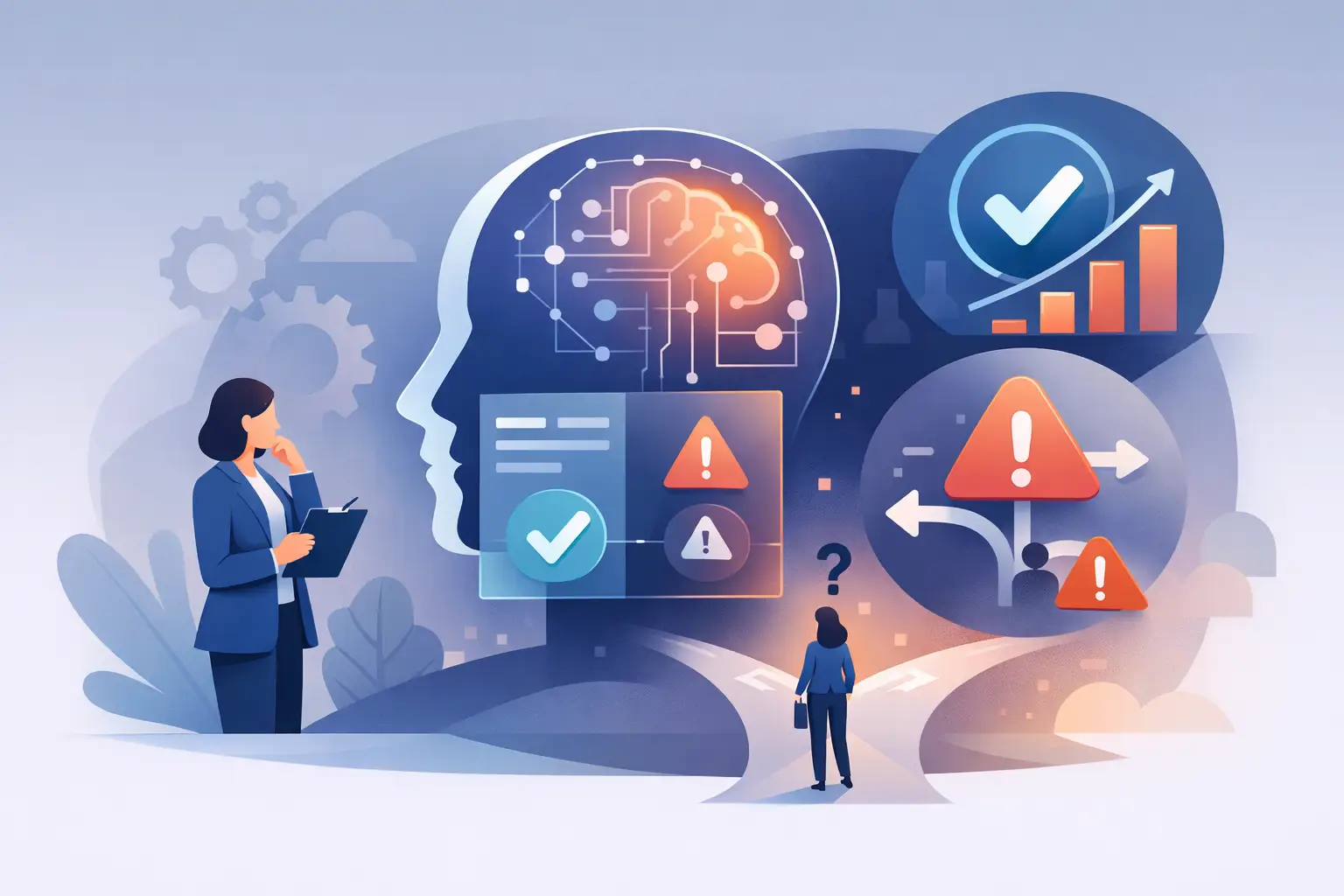
A polished AI response can feel like a shortcut to certainty. It may be well organized, confident, and even persuasive. But learning how to evaluate AI output is what separates people who merely use new technology from people who use it to make stronger decisions, build better careers, and create real economic opportunity.
AI can help you draft a proposal, research a market, analyze customer feedback, prepare for an interview, or outline a new business idea. It can also state false information with total confidence, miss crucial context, and reflect assumptions that do not fit your goals. The opportunity is not to treat AI like an oracle. The opportunity is to become the person who can direct it, question it, and turn its output into action.
How to Evaluate AI Output With Clear Standards
The first question is not, Is this answer impressive? The first question is, Is this answer useful for the decision I need to make?
That distinction matters. An AI tool may write a beautiful explanation of a marketing strategy that has nothing to do with your customer, budget, location, or industry. It may offer career advice based on generic assumptions when your real advantage lies in your specific experience and relationships. Quality starts with relevance.
Before accepting an answer, return to the original task. What were you trying to accomplish? Who will use this information? What could happen if the answer is wrong? A social media caption has a low cost of error. Advice about a contract, medical situation, tax decision, hiring choice, or major investment has a much higher cost of error. The higher the stakes, the more carefully you should verify the result.
A useful mental standard is simple: AI can accelerate your work, but you remain accountable for the outcome. That is not a burden. It is a source of professional value. As more people gain access to the same tools, sound judgment becomes a competitive advantage.
Check the facts, not just the writing
AI is designed to generate likely language, not to guarantee truth. It can produce names, statistics, dates, quotations, legal rules, and research citations that sound credible but are incomplete, outdated, or entirely fabricated.
When the output includes claims that will influence a decision, isolate those claims and verify them independently. Start with the details that matter most: numbers, dates, sources, legal requirements, product specifications, and statements about competitors or customers. Do not assume a citation is real simply because it looks formal. Confirm that the source exists, says what the AI claims it says, and applies to your situation.
This does not mean every AI-generated sentence needs a full investigation. It means your effort should match the risk. If you are using AI to brainstorm ten headlines, speed matters more than perfect factual precision. If you are using it to advise a client or shape a business plan, facts deserve direct attention.
Look for missing context
Many weak AI answers are not obviously false. They are incomplete.
Ask what the tool may not know. Has it considered your state, industry, company size, target customer, time frame, financial limits, or personal priorities? Has it assumed that a broad trend applies equally to every worker or business? Context is where human experience still makes the difference.
Imagine an AI tool recommends that a small business lower prices to compete. That advice might work in a crowded market with price-sensitive buyers. It could also damage a premium brand, reduce margins, and attract customers who will leave at the first discount. The answer is not automatically bad. It simply needs to be tested against the reality of the business.
A good follow-up prompt can expose gaps quickly. Ask the AI to identify its assumptions, explain what information could change its recommendation, and present the strongest argument against its own conclusion. This turns a one-way answer into a more useful working conversation.
Test AI Output Against Your Judgment
The purpose of evaluation is not to prove the machine wrong. It is to combine machine speed with human responsibility.
Read the output as an editor, manager, customer, or decision-maker would. Does the reasoning actually lead to the recommendation? Are there leaps in logic? Does the answer confuse correlation with cause? Does it offer broad promises without explaining what would need to happen first?
Pay special attention to confident language. Phrases such as will increase, always works, or is the best option should make you pause unless the evidence is unusually strong. Real business and career decisions usually involve trade-offs. A recommendation that recognizes risks, limitations, and alternatives is often more trustworthy than one that sounds certain about everything.
It also helps to compare the AI response with what you already know. If the answer contradicts your firsthand experience, do not reject it immediately. Investigate the difference. Maybe the AI has surfaced a perspective you had not considered. Or maybe it has missed a fact that only someone close to the work could understand. Either way, the tension can lead to a better decision.
Watch for bias and borrowed assumptions
AI systems learn patterns from large amounts of human-created material. That means their output can repeat common stereotypes, conventional wisdom, or hidden assumptions. It may describe one type of worker as more capable, frame one business model as the default, or overlook communities and customers that do not fit the most common data patterns.
Ask whose perspective is centered in the answer and whose perspective may be absent. If you are writing hiring criteria, customer messaging, performance reviews, or policy recommendations, this step is especially important. A response can be technically polished and still be unfair, narrow, or poorly suited to the people affected by it.
The same principle applies to ambition. AI may steer you toward familiar career paths because they are heavily represented in its training data. But your American Dream does not have to follow the most common route. Your skills, appetite for risk, family responsibilities, and definition of success should shape the plan.
Protect information that should stay private
Evaluation also includes deciding what should never be entered into an AI system in the first place. Do not casually paste confidential business plans, private customer information, employee records, passwords, financial account details, or sensitive personal information into a tool unless you understand the platform's policies and your organization's rules.
This is practical leadership. The most valuable people in an AI-driven workplace will not be those who hand every problem to a chatbot. They will be the people who know where speed helps, where privacy matters, and where human review is nonnegotiable.
Turn a Good Draft Into a Better Result
AI output is often most valuable as a first draft. Treat it as raw material that you refine with your experience, standards, and goals.
If an answer is too generic, provide stronger inputs. Share the audience, desired outcome, constraints, examples of what has worked before, and the tone you want. If it makes an unsupported claim, ask it to distinguish verified facts from assumptions. If it gives one recommendation, ask for two alternatives with different costs and risks.
You can also ask the tool to show its work in a practical way. Request a step-by-step rationale, a list of assumptions, a risk analysis, or a plan for validating the recommendation. Then review those elements rather than judging only the final paragraph. Better questions produce better material, but better judgment determines whether that material deserves your trust.
For larger projects, create a simple review process. Use AI to generate options, verify the important claims, compare the result with your goals, and make a final decision with the people who own the outcome. This approach prevents both extremes: fear that avoids useful technology and blind trust that creates avoidable mistakes.
Build the Skill That AI Cannot Replace
The future of work will reward people who can move from information to judgment. AI makes it easier to create words, images, summaries, and plans. It does not remove the need to decide what is true, what is ethical, what is relevant, and what is worth doing.
That is encouraging news for workers, professionals, and entrepreneurs. Your value is not limited to performing routine tasks faster than a machine. Your value grows when you can frame the right problem, recognize weak reasoning, understand people, and act with responsibility.
Each time you use AI, practice one habit: pause before you act. Check the facts that matter, question the assumptions, add the context only you possess, and make the final call with intention. That is how a powerful tool becomes a source of greater freedom, confidence, and opportunity.
