
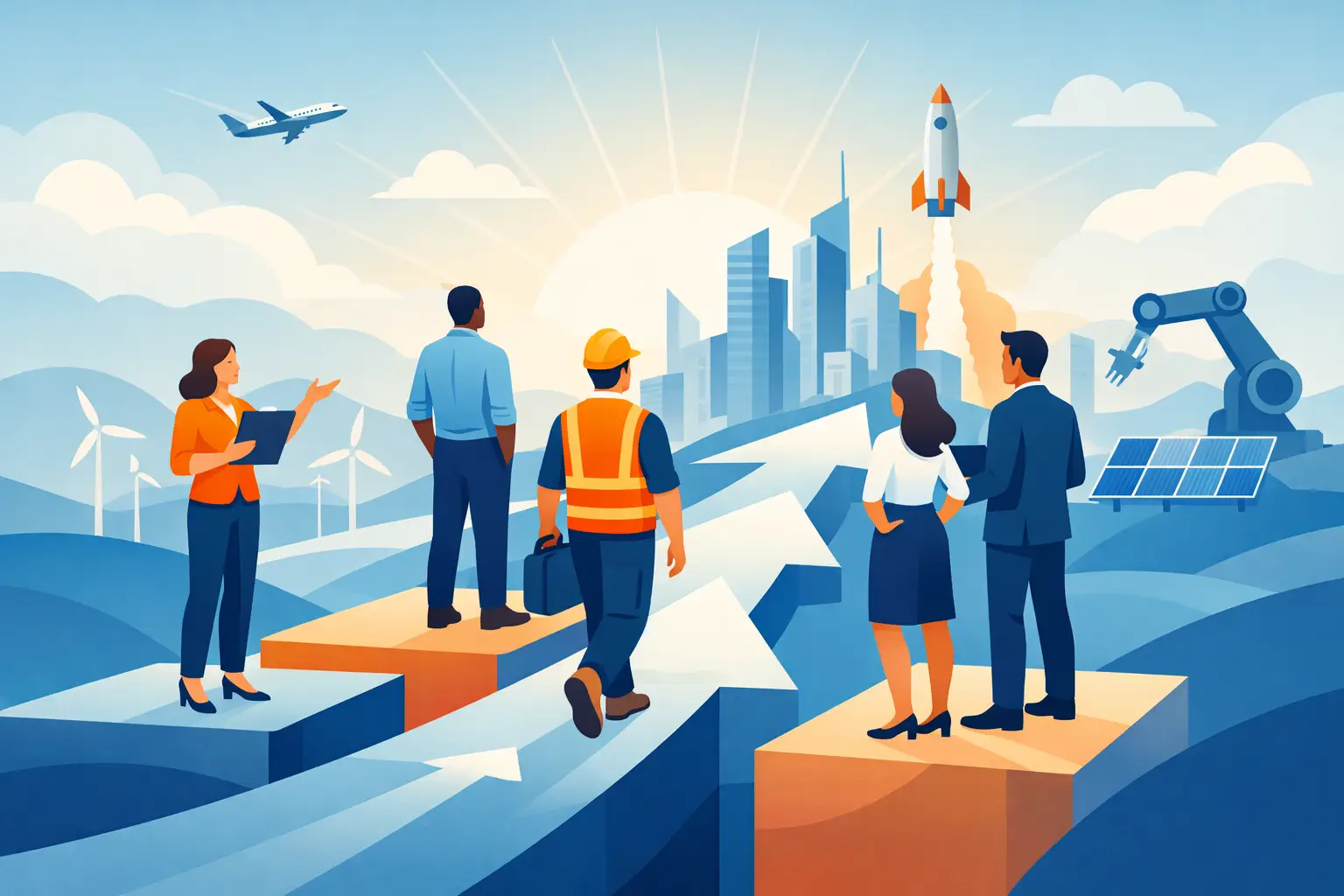
A customer service representative who learns to direct an AI assistant can handle more complex cases, build stronger client trust, and become more valuable to the business. A bookkeeper who uses AI to spot errors can spend more time advising clients. A project manager who understands automation can lead teams through change instead of watching change happen to them.
That is the real story behind the future of middle class work. It is not simply a question of which jobs disappear. It is a question of who chooses to grow from task-doer into problem-solver, guide, builder, and leader.
For generations, the American middle class was built on dependable work, practical skills, and the belief that effort could create a better life. Those values still matter. But the definition of a dependable skill is changing quickly. The workers who prosper will not be the ones who wait for certainty. They will be the ones who learn how to make powerful new tools serve human ambition.
Why Middle Class Work Is Being Redefined
Artificial intelligence is changing work first by changing tasks. It can draft an email, summarize a meeting, organize research, create a first-pass spreadsheet, write basic code, and answer routine questions in seconds. This affects office roles, skilled trades, health care, logistics, education, sales, finance, and small business ownership.
That does not mean every affected job is gone. Most jobs are bundles of tasks, and only some of those tasks can be automated well. A nurse does far more than record information. A real estate professional does more than fill out forms. An operations manager does more than create reports. They interpret circumstances, earn confidence, make judgments when information is incomplete, and accept responsibility for outcomes.
AI raises the value of those distinctly human contributions. When routine production becomes faster and cheaper, discernment matters more. So does communication. So does the ability to see a customer's real problem before the customer can fully explain it.
The risk is real for workers whose roles remain limited to repeatable, predictable output. If an employer can get the same basic result from software, that work will face pressure. The opportunity is equally real for people who can use the software to create better results, faster decisions, stronger service, or new revenue.
The Future of Middle Class Work Will Reward Leverage
In the past, career advancement often followed a familiar path: gain experience, work hard, wait for a promotion, and gradually earn more responsibility. That path still exists, but it is no longer enough on its own. AI gives an individual the ability to produce work that once required a larger team or more specialized support.
This is leverage. It can make a motivated employee more productive, but it can also make a small business owner more competitive. A local contractor can improve estimates and customer follow-up. An independent consultant can research markets faster. A teacher can customize practice materials. A marketing professional can test more ideas without adding hours to the day.
Leverage is not a promise that work will become effortless. In many cases, expectations will rise because more can be done. The difference is that workers with the right skills can spend less time on administrative drag and more time on judgment, relationships, creativity, and execution.
That shift creates a new dividing line. The most secure workers will not necessarily be the people with the longest tenure or the most impressive job title. They will be people who can identify where time is being wasted, use technology responsibly, and connect their efforts to a result the organization values.
Human Skills Are Becoming Economic Skills
There is a mistake people make when they hear that AI will reshape employment. They assume the answer is to become more like a machine. The opposite is closer to the truth.
The people who stand out will be able to ask better questions, explain complicated ideas plainly, negotiate competing priorities, build trust, and make ethical choices. AI can generate options. It cannot carry your reputation, understand the full history of a client relationship, or replace the confidence a team feels in a leader who takes ownership.
Consider a financial advisor using AI to prepare market summaries. The technology may speed up preparation, but the client still needs someone who understands their goals, fears, family situation, and tolerance for risk. In health care, AI may help organize information, while patients still depend on professionals who can listen, explain, and care.
This is why communication is not a soft skill. It is a career asset. Judgment is not vague. It is valuable. Reliability is not old-fashioned. It is a competitive advantage when change makes people uncertain.
Build an AI-Ready Career Before You Feel Ready
You do not need to become a programmer to participate in the AI economy. You do need a working understanding of where AI can help, where it can fail, and how to check its work. Start with the tasks already in front of you.
Look for work that is repetitive, time-consuming, or based on sorting information. Learn to use an AI tool to create a first draft, identify patterns, organize ideas, or prepare questions. Then review the result with your own expertise. Never hand over your judgment to a tool that can be wrong, biased, or missing context.
The goal is not to claim that AI did your job. The goal is to become the person who can produce a better job because you know how to direct it. That distinction matters to employers, customers, and future business partners.
It also helps to develop a visible record of adaptability. Volunteer for a process improvement project. Learn the basics of data literacy. Document a workflow you improved. Share useful ideas with your manager. If you own a business, measure how much time a new process saves and whether customers notice better service.
Small gains compound. An hour saved each week can become time for training, prospecting, strategic thinking, or family. A new skill practiced consistently can become the proof that qualifies you for a better role.
Workers Must Think Like Owners
The American Dream has never been only about holding a job. It has been about creating options: the option to support a family, buy a home, start a business, move up, and leave something stronger for the next generation.
That mindset is especially powerful now. Thinking like an owner means paying attention to value, not just activity. It means asking: What problem does my work solve? What result does my employer or customer actually need? How could I deliver that result more effectively?
For some people, the answer will lead to advancement inside an organization. For others, it will lead to a side business, freelance work, consulting, or a new company. AI lowers some barriers to starting, researching, marketing, and operating a business. It does not eliminate the need for discipline, customer understanding, or a willingness to earn trust over time.
Entrepreneurship is not the right path for everyone, and not every AI tool is worth adopting. Some work requires privacy, precision, licensing, or hands-on expertise that cannot be casually automated. The wise approach is practical optimism: use technology where it improves your work, protect the areas where human accountability matters most, and keep learning as the tools evolve.
A More Demanding but More Open Future
The future will demand more initiative from middle-class workers. There is no reason to pretend otherwise. Some career paths will narrow, and some companies will use automation mainly to cut costs. Workers deserve honest preparation, not empty reassurance.
But disruption also creates openings. New roles appear around implementation, training, quality control, customer success, cybersecurity, data management, and AI-assisted operations. Existing roles can become more meaningful when people are freed from low-value tasks and trusted to solve bigger problems.
The worker who sees AI only as a threat may hesitate until choices are made for them. The worker who sees it as a tool can begin building choices now. Learn one useful capability. Improve one process. Strengthen one human skill that software cannot duplicate. Then do it again next month.
The future of work will not be decided only in boardrooms or technology labs. It will be shaped in everyday decisions by people who refuse to let change shrink their ambition. Your next advantage may begin with a simple question: How can I use this moment to become more useful, more capable, and more free?
